Business setup in UAE comes down to one question first: who will you sell to? Answer that, and the choice between mainland, free zone and offshore usually makes itself.
Business setup in the UAE means registering a legal entity and obtaining a trade licence from a mainland economic department, a free zone authority or an offshore registry. All three allow 100% foreign ownership for most activities, but they differ in where you can trade, residence visa eligibility, premises and how Corporate Tax applies. Offshore registries issue a certificate of incorporation rather than an operating trade licence.
We are chartered accountants, so we look at a new company the way the Federal Tax Authority will: from the first tax registration onwards. This guide covers the three routes, what changed in 2025 and 2026, realistic costs, the steps, and the compliance deadlines that start the day your licence is issued.
Get setup advice on WhatsApp Find your best option in 30 seconds
Key takeaways
- Choose mainland if most of your customers are in the UAE, you need a shop or warehouse, or you want government contracts.
- Choose a free zone for consultancy, e-commerce or international trade where low cost and fast setup matter.
- Choose offshore only to hold assets, shares or IP, or to trade outside the UAE. Offshore companies get no visas.
- Since 2025, eligible Dubai free zone companies can apply to serve the mainland, and companies can transfer between free zone and mainland where both authorities approve.
- Every new UAE company must apply for Corporate Tax registration within 3 months of incorporation. Late registration normally costs AED 10,000.
Your three routes
What are the options for business setup in UAE?
Every UAE company is licensed in one of three types of jurisdiction. The trade licence decides where you can sell, which activities you can carry out and how many residence visas your company can sponsor.
Sell inside the UAE
Mainland company
Licensed by the emirate’s economic department, such as the Department of Economy and Tourism (DET) in Dubai or ADDED in Abu Dhabi.
- Trade anywhere in the UAE and abroad
- Shops, warehouses and government tenders
- Visa eligibility depends on activity, premises and approvals
- Most licences need premises with a registered tenancy; some activities qualify for simplified options such as Dubai’s Instant Licence
Low cost, fast setup
Free zone company
Licensed by one of the free zone authorities, such as DMCC, IFZA, Meydan, RAKEZ, SPC Free Zone, Shams or Ajman Free Zone.
- Trade within the free zone and internationally
- Flexi-desk options keep rent low
- Visa allocation depends on package, workspace and approvals
- Possible 0% Corporate Tax on qualifying income
Hold, not trade
Offshore company
Registered with an offshore registry such as RAK ICC or JAFZA Offshore through a registered agent. It receives a certificate of incorporation, not an operating trade licence.
- Holding shares, property or intellectual property
- International trade outside the UAE
- No office lease and no residence visas
- Cannot trade with customers in the UAE
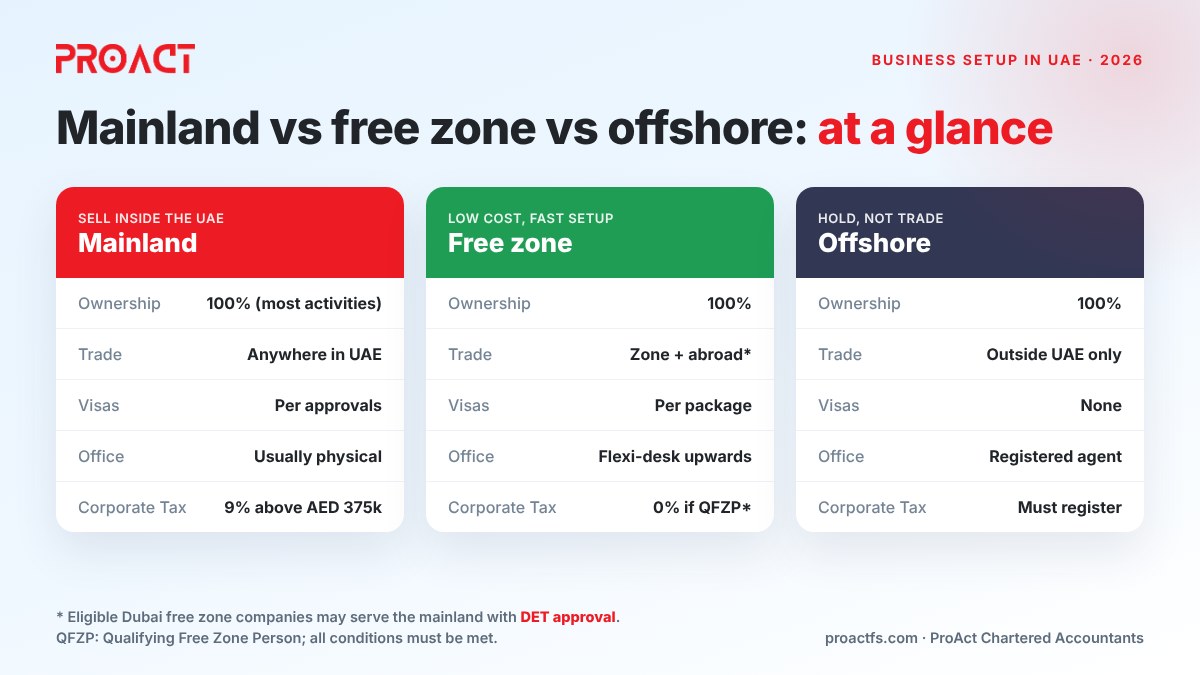
Side by side
Mainland vs free zone vs offshore: which business setup in UAE fits you?
This is the comparison we walk clients through in the first meeting. Read across the rows that matter most to your business model.
| Mainland | Free zone | Offshore | |
|---|---|---|---|
| Licensing body | Economic department of the emirate (DET, ADDED, SEDD and others) | The free zone authority | Offshore registry (RAK ICC, JAFZA Offshore); certificate of incorporation |
| Foreign ownership | 100% for most activities; some strategic activities restricted | 100% | 100% |
| Where you can trade | Anywhere in the UAE and abroad | Inside the free zone and abroad; Dubai mainland through a DET licence or permit where eligible, or a distributor | Outside the UAE only |
| Office | Usually premises with registered tenancy; simplified options for some activities | Flexi-desk to full office or warehouse | None; registered agent address |
| Residence visas | Depend on activity, premises and approvals | Depend on package, workspace and approvals | Not available |
| Corporate Tax | 9% on taxable income above AED 375,000 | 0% on qualifying income if all Qualifying Free Zone Person conditions are met; 9% on other taxable income | Registration required; 0% possible only where the registry is a recognised free zone and conditions are met |
| Government contracts | Yes | Generally no | No |
| Typical setup time | 1–3 weeks | 3–10 working days | 1–2 weeks |
| Best for | Retail, contracting, trading and services to UAE customers | Consultants, e-commerce, startups and international trade | Holding companies and asset protection |
Setup times are typical ranges after documents are complete and exclude visa processing and bank account opening.
Updated for 2026
What changed for business setup in the UAE in 2025 and 2026?
Three changes have blurred the old line between mainland and free zone. Older guides online miss all three, and each can change which structure is right for you.
01
Dubai free zone companies can serve the mainland
Under Dubai Executive Council Resolution No. 11 of 2025, an eligible Dubai free zone company can apply to DET for a mainland branch licence, a licence to operate from the free zone, or a temporary permit of up to six months, with its free zone’s approval. Eligibility depends on the activity. It must keep separate accounts for the mainland activity, and DIFC financial firms are excluded.
02
Companies can move between free zone and mainland
Federal Decree-Law No. 20 of 2025, in force since October 2025, lets a company transfer its registration between a free zone and the mainland without dissolving, subject to both authorities’ approval, their systems and other legal conditions. Mainland LLCs can also issue different classes of shares.
03
RAK ICC is now a free zone for Corporate Tax
Cabinet Resolution No. 109 of 2026 added RAK ICC to the list of free zones for Corporate Tax, backdated to 1 June 2023. RAK ICC companies can now pay 0% on qualifying income, but only if they meet every Qualifying Free Zone Person condition. It is not automatic.
What this means in practice: eligible free zone companies now have more flexibility than before. Mainland permits and transfers still depend on approvals, permitted activities and tax requirements, so if your business mainly serves UAE customers, a mainland licence is often still the direct route.
Free 20-minute consultation
Not sure which structure fits?
Tell us your activity, where your customers are and how many visas you need. A chartered accountant will recommend a structure and send an itemised quote.
WhatsApp a chartered accountant See our business setup services
Budget
How much does business setup in UAE cost in 2026?
Fees vary by emirate, authority, activity and visa count, so treat these as first-year planning ranges rather than quotes.
| Cost item | Typical range (AED) |
|---|---|
| Free zone licence, no visa, at SPC Free Zone (package conditions apply) | From 5,750 |
| Mainland trade licence, depending on activity and emirate | 15,000–50,000 |
| Each residence visa (entry permit, medical, Emirates ID) | 3,500–7,000 |
| Office or flexi-desk rent, per year | 4,000–30,000 |
| One-off admin (MoA notarisation, translation, e-channel) | 1,000–5,000 |
| Outsourced PRO services, per year | 5,000–15,000 |
| Offshore company (RAK ICC or JAFZA Offshore): registry fee plus registered agent | Quote per registry |
Ranges from our full UAE business setup cost guide. Government and free zone fees change, so always confirm with a current quote.
The cheapest licence is rarely the cheapest company. A no-visa free zone licence looks attractive until you need a residence visa, a bank that wants to see real premises, or a contract with a mainland customer. Price the whole first year, including visas, office, bookkeeping and tax registrations, before you choose.
Tax from day one
How do Corporate Tax and VAT affect your business setup in UAE?
Your structure decides your tax position for years, so it is worth settling before the licence is issued rather than after.
Corporate Tax
- 0% on taxable income up to AED 375,000 and 9% above it.
- Small Business Relief is available to eligible UAE resident companies with revenue up to AED 3 million in the current and every previous tax period, for tax periods ending on or before 31 December 2029. It must be elected each year and is not available to Qualifying Free Zone Persons or large multinational group members.
- A Qualifying Free Zone Person may pay 0% on qualifying income if it meets every condition: qualifying activities and income, adequate substance, audited accounts, transfer pricing compliance and the de minimis test. Other taxable income is taxed at 9% with no AED 375,000 zero band. A free zone licence alone does not guarantee 0%.
- Audited financial statements are required if revenue exceeds AED 50 million, and for every Qualifying Free Zone Person.
VAT
- Registration is mandatory once taxable supplies and imports pass AED 375,000 in the last 12 months, or are expected to within the next 30 days. Zero-rated supplies count.
- Voluntary registration is possible once taxable supplies, imports or taxable expenses pass AED 187,500, which helps if you have large start-up costs with VAT to recover.
- Being in a free zone does not make your sales VAT-free. Only certain goods movements in designated zones are treated differently.
- E-invoicing: B2B and B2G businesses with revenue of AED 50 million or more go live on 1 January 2027; those below AED 50 million must appoint an accredited provider by 31 March 2027 and go live on 1 July 2027.
Read more in our Qualifying Free Zone Person guide, our guide to UAE e-invoicing for SMEs and our e-invoicing services.
Step by step
How to complete business setup in UAE: 8 steps
The order is broadly the same in every jurisdiction. Most delays come from incomplete shareholder documents and bank onboarding, not from the licence itself.
- Define your activity and customersList the exact activities you will carry out and where your customers are. This decides the jurisdiction, the licence type and whether any external approvals are needed.
- Choose the jurisdiction and authorityPick mainland, a specific free zone or an offshore registry, comparing cost, visa packages, location and banking acceptance.
- Reserve a trade name and get initial approvalThe name must follow the authority’s naming rules. Initial approval confirms that the authority has no objection to your activity and shareholders.
- Prepare and sign the documentsPassport copies, the Memorandum of Association, and for corporate shareholders, attested board resolutions and incorporation documents. Some activities need a business plan or third-party approvals.
- Secure an office or flexi-deskMost mainland licences need a registered tenancy contract. Free zones offer packages from flexi-desks upwards. Offshore companies use their registered agent.
- Receive the licence and establishment cardOnce fees are paid, the trade licence (or, offshore, the certificate of incorporation) is issued. The immigration establishment card may be a separate application, depending on the authority and package.
- Apply for residence visasEntry permit, medical test, then residence permit issuance and Emirates ID processing for investors and staff, within the company’s approved allocation.
- Open the corporate bank accountBanks carry out full KYC on the company and its owners, including source of funds and expected transactions. Allow several weeks and prepare a clear business profile.
After the licence
What must a new UAE company do in its first 90 days?
Most setup agents stop at the licence. The deadlines below start the day it is issued, and missing them brings penalties before your first sale.
| When | Requirement | Rule |
|---|---|---|
| At licensing, then within 60 days | Disclose Ultimate Beneficial Owners during licensing, set up the UBO and shareholder registers within 60 days, and record changes within 15 days | Cabinet Decision No. 109 of 2023 |
| Within 3 months of incorporation | Apply for Corporate Tax registration with the FTA (late penalty normally AED 10,000; an FTA waiver may apply if conditions are met) | FTA Decision No. 3 of 2024 |
| Within 30 days of the threshold being met | Register for VAT once taxable supplies and imports exceed AED 375,000, or are expected to within 30 days | Federal Decree-Law No. 8 of 2017 |
| Before starting activity | Register on goAML if you are a DNFBP, such as a real estate broker, gold dealer or corporate service provider | AML/CFT law and regulations |
| From day one | Keep accounting records and supporting documents for at least 7 years | Corporate Tax Law |
| Before first year-end | Confirm your financial year, audit requirement and Qualifying Free Zone Person status | Ministerial Decision No. 84 of 2025 |
Your first Corporate Tax return is generally due within 9 months after the end of your first tax period. Economic Substance Regulations reporting and substance tests no longer apply to financial years ending after 31 December 2022, so new companies do not file ESR notifications, although separate substance rules apply to Qualifying Free Zone Persons.
Quick check
Which business setup in UAE suits you?
Answer three questions for a starting recommendation. We will confirm it against your activity before you spend anything.
Pick one answer for each question to see your result.
Our starting recommendation
Get an itemised quote on WhatsAppHow we help
Business setup with your accountant in the room
ProAct is a UAE firm of chartered accountants and tax consultants. We set up companies with the tax and compliance consequences already worked out, then keep the books once you are trading, so nothing falls between a formation agent and an accountant.
Set up
Company formation
- Structure and jurisdiction advice
- Trade name, initial approval and licence
- MoA and shareholder documents
- Mainland, free zone and offshore
Get running
Visas, PRO and banking
- Establishment card and residence visas
- Emirates ID and medical coordination
- Bank account documentation support
- Licence renewals and amendments
Stay compliant
Tax and bookkeeping
- Corporate Tax and VAT registration
- UBO register and goAML where needed
- Monthly bookkeeping from day one
- Audit and Qualifying Free Zone Person support
Start the right way
Get a structure recommendation and an itemised quote
Share your activity, shareholders and visa needs. We will reply with the right structure, all first-year costs and the tax registrations you will need.
WhatsApp +971 50 725 6685 Book a consultation
✔ Chartered Accountants✔ Mainland, Free Zone & Offshore✔ Tax registrations included in advice
Comparing free zones? See our UAE free zones guide, or our DMCC company formation guide for Dubai.
FAQs
Business setup in UAE: frequently asked questions
Yes, for most commercial and industrial activities. Since 2021 the UAE has allowed full foreign ownership of mainland companies, with a short list of strategic-impact activities still restricted. Some professional licences in certain emirates still require a UAE national as a local service agent, who has no ownership.
A no-visa free zone licence is usually the lowest entry cost, with packages starting from about AED 5,750 at SPC Free Zone (Sharjah Publishing City), subject to package conditions. The total first-year cost rises with residence visas, office space, bookkeeping and tax registrations, so compare full first-year costs rather than licence fees alone.
In Dubai, yes, if the activity is eligible and approvals are granted. Under Executive Council Resolution No. 11 of 2025, a Dubai free zone company can apply to the Department of Economy and Tourism for a branch licence or a temporary permit of up to six months, subject to its free zone's approval and separate accounting. Elsewhere, free zone companies generally reach mainland customers through a distributor or a mainland branch.
No. A UAE offshore company, such as one registered with RAK ICC or JAFZA Offshore, receives a certificate of incorporation rather than a trade licence. It cannot trade with customers inside the UAE, lease an office or sponsor residence visas. It is used to hold shares, property in approved areas or intellectual property, and for trade outside the UAE.
Yes. A company incorporated in the UAE must generally apply for Corporate Tax registration within 3 months of incorporation under FTA Decision No. 3 of 2024, even if it expects no profit. Late registration normally attracts an AED 10,000 penalty, although the FTA's penalty waiver may apply if its conditions are met.
A free zone licence can be issued in about 3 to 10 working days once documents are complete, and a mainland licence typically takes 1 to 3 weeks. Residence visas and corporate bank account opening usually add several more weeks.
Yes, where both authorities permit it and the legal conditions are met. Federal Decree-Law No. 20 of 2025 allows a company to transfer its registration between a free zone and the mainland without dissolving and re-incorporating, so it keeps its legal identity, contracts and history.
Offshore companies incorporated in the UAE must register for Corporate Tax. RAK ICC was added to the list of free zones for Corporate Tax by Cabinet Resolution No. 109 of 2026, with effect from 1 June 2023, so a RAK ICC company that meets every Qualifying Free Zone Person condition can pay 0% on qualifying income. Its other taxable income is taxed at 9%, without the AED 375,000 zero band.
- KPMG: Dubai Executive Council Resolution No. 11 of 2025 on free zone companies operating on the mainland
- Baker McKenzie: Amendments to the Commercial Companies Law (Federal Decree-Law No. 20 of 2025)
- PwC: RAK ICC recognised as a free zone for UAE Corporate Tax purposes
- Deloitte: FTA Decision No. 3 of 2024 on Corporate Tax registration timelines
- Farahat & Co: Ministerial Decision No. 131 of 2026 extending Small Business Relief to 2029
- Cabinet Decision No. 109 of 2023: Regulating the procedures of the Real Beneficiary (PDF)
- Federal Tax Authority: Corporate Tax and VAT legislation and guides
This article is general guidance based on rules in force as of 11 November 2026 and is not legal or tax advice for your situation. Fees and regulations change; contact ProAct to confirm how they apply to your business.
Author Bio:
Written By,