The United Arab Emirates (UAE) is a global business magnet. To ensure the country’s continued credibility, UAE authorities have strengthened their Anti-Money Laundering (AML) frameworks aligned with FATF standards. AML compliance is now mandatory across many sectors — not just banks, but also real estate, gold dealers, legal professionals, and even crypto exchanges.
Failing to comply can expose your business to heavy penalties, operational restrictions, or even license cancellation.
At ProAct, we streamline AML compliance efficiently, offering tailored services so you stay ahead of regulatory demands.
This guide explains:
- Which businesses need AML compliance in the UAE
- The exact obligations and thresholds
- Sub-sector nuances within DNFBPs
- How ProAct supports businesses with complete, stress-free compliance
- 20 detailed FAQs for practical understanding
UAE’s AML Regulatory Framework: An Overview
Key laws shaping UAE’s AML landscape include:
- Federal Decree-Law No. (20) of 2018 on Anti-Money Laundering and Combating the Financing of Terrorism
- Cabinet Decision No. (10) of 2019 regarding the Implementing Regulation
- Guidelines for DNFBPs issued by the Ministry of Economy, DFSA (for DIFC entities), and FSRA (for ADGM entities)
- Cabinet Decision No. (74) of 2020 for Beneficial Ownership Requirements
💡 Official Source: UAE Ministry of Economy AML Page
Businesses Required to Implement AML Compliance in UAE
The following sectors are mandated by law to have full AML programs in place:
1. Financial Institutions
These are naturally high-risk entities, regulated primarily by:
- Central Bank of the UAE
- Securities and Commodities Authority (SCA)
Entities include:
- Banks
- Exchange houses
- Insurance firms
- Investment companies
- Payment service providers
2. Designated Non-Financial Businesses and Professions (DNFBPs)
According to the Ministry of Economy, DNFBPs include:
| Category | Example Entities | Regulator |
|---|---|---|
| Real Estate Agents and Brokers | Property developers, brokers | Ministry of Economy |
| Dealers in Precious Metals/Stones | Jewelry stores, gold traders, diamond merchants | Ministry of Economy |
| Legal Professionals | Law firms, notaries | Ministry of Justice |
| Accounting/Auditing Professionals | Audit firms, freelance accountants | Ministry of Economy |
| Corporate Service Providers | Company formation agents, nominee directors | Ministry of Economy |
Nuanced DNFBP Sub-Sectors:
- Art and Antiquities Dealers (luxury goods, paintings, artifacts)
- Crowdfunding Platforms (depending on model and financial exposure)
- Corporate Trustees and Foundations Managers
3. Virtual Asset Service Providers (VASPs)
The UAE has emerging VASP-specific frameworks like:
- Dubai VARA (Virtual Assets Regulatory Authority)
- ADGM FSRA VASP Regulations
Entities include:
- Crypto exchanges
- Digital wallet providers
- NFT marketplace operators (select cases)
💡 Official Source: Dubai VARA
4. High-Value Goods Dealers
Any business accepting cash transactions exceeding AED 55,000 must implement AML measures. This includes:
- Luxury car dealerships
- Jewelry shops
- Art galleries
- Luxury watch sellers
5. Non-Profit Organizations (NPOs)
Certain charities are monitored to prevent misuse for terrorism financing, governed by:
Local authorities like Dubai’s Islamic Affairs and Charitable Activities Department
Ministry of Community Development
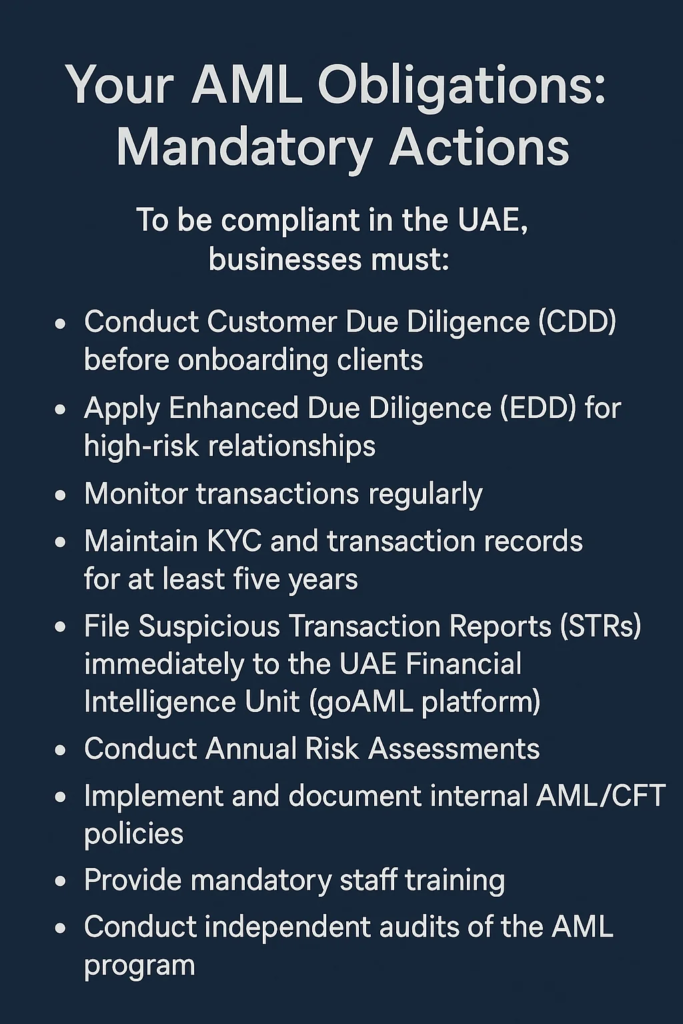
Your AML Obligations: Mandatory Actions
To be compliant in the UAE, businesses must:
- Conduct Customer Due Diligence (CDD) before onboarding clients
- Apply Enhanced Due Diligence (EDD) for high-risk relationships
- Monitor transactions regularly
- Maintain KYC and transaction records for at least five years
- File Suspicious Transaction Reports (STRs) immediately to the UAE Financial Intelligence Unit (goAML platform)
- Conduct Annual Risk Assessments
- Implement and document internal AML/CFT policies
- Provide mandatory staff training
- Conduct independent audits of the AML program
AML for DNFBPs in UAE: A Deeper Look
DNFBPs represent some of the highest-risk industries for money laundering. In the UAE, regulatory authorities like the Ministry of Economy and Financial Services Regulatory Authority (FSRA) monitor DNFBPs closely.
Example 1:
A real estate agency in Dubai sells a property worth AED 6 million. The buyer offers to pay AED 800,000 in cash upfront.
👉 They must conduct enhanced due diligence and report the transaction if suspicious.
Example 2:
A jewelry dealer notices a customer purchasing AED 100,000 worth of gold in cash under different names.
👉 They must file an STR immediately.
ProAct specializes in helping DNFBPs implement customized AML programs with minimal disruption to daily operations.
Penalties for AML Non-Compliance in UAE: Fines You Must Know

Businesses that fail to meet AML compliance obligations in the UAE face serious financial and legal consequences. The Ministry of Economy and relevant regulators (like the Central Bank of the UAE, Dubai VARA, and ADGM FSRA) routinely impose administrative fines ranging from AED 50,000 to AED 5,000,000 depending on the severity of the violation.
Common reasons for fines include:
- Failure to register with the goAML platform
- Non-submission of Suspicious Transaction Reports (STRs)
- Lack of proper Customer Due Diligence (CDD) documentation
- Weak internal AML policies and procedures
- Failure to identify and verify Ultimate Beneficial Owners (UBOs)
- Non-cooperation with Financial Intelligence Unit (FIU) inspections
In extreme cases, penalties can escalate to license suspension, public naming and shaming, or even criminal prosecution.
➡️ ProAct ensures your compliance program is airtight, preventing costly fines and reputational damage.
Why Choose ProAct for AML Compliance in UAE?
🔹 Expertise Across Sectors: From banks to crypto platforms to DNFBPs.
🔹 Custom Solutions: No “one-size-fits-all” — your AML system is built to match your risk.
🔹 Speed and Efficiency: Set up your AML framework within 2–4 weeks.
🔹 Continuous Support: We stay with you post-setup for reporting, audits, and regulatory updates.
🔹 Training & Workshops: Interactive, practical, and regulator-approved.
➡️ Unsure if you need AML compliance? Contact ProAct for a free AML risk assessment.
Frequently Asked Questions: Detailed FAQs on AML Compliance in UAE
1. What does AML mean?
AML stands for Anti-Money Laundering, a framework of laws, regulations, and procedures designed to prevent criminals from disguising illegally obtained funds.
2. Is AML compliance mandatory for all businesses in the UAE?
No, but it is mandatory for high-risk sectors like financial institutions, DNFBPs, VASPs, and certain NPOs.
3. Who are DNFBPs?
Designated Non-Financial Businesses and Professions (DNFBPs) include real estate brokers, dealers of precious metals, lawyers, accountants, and corporate service providers.
4. What is Customer Due Diligence (CDD)?
CDD involves verifying the identity of your clients and assessing their risk before establishing a business relationship.
5. What is Enhanced Due Diligence (EDD)?
EDD refers to applying stricter scrutiny and additional verification for high-risk customers or transactions.
6. What happens if I don’t comply with AML regulations?
Penalties include fines (up to AED 5 million), license suspension, and reputational damage.
7. What is a Suspicious Transaction Report (STR)?
An STR is a report filed to the Financial Intelligence Unit (FIU) when suspicious activity is detected.
8. Who regulates AML compliance for DNFBPs?
In the UAE, the Ministry of Economy primarily regulates DNFBPs.
9. How often should AML risk assessments be conducted?
At least annually or when there are significant changes in your business activities.
10. Can small businesses be exempt from AML obligations?
No. Even small businesses in high-risk sectors must comply fully.
11. What are the fines for non-compliance?
Fines range from AED 50,000 to AED 5 million depending on the severity of the violation.
12. How does ProAct help businesses with AML compliance?
We offer end-to-end services: risk assessments, policy creation, training, monitoring, and reporting.
13. What training does ProAct offer?
AML workshops, customized staff training, and e-learning modules.
14. What is transaction monitoring?
It’s the process of reviewing financial transactions to detect suspicious activities.
15. What sectors are considered high-risk for money laundering?
Real estate, precious metal dealers, cryptocurrency firms, and high-value luxury businesses.
16. How long must AML records be kept?
Minimum five years from the end of the business relationship or transaction.
17. Can AML compliance be outsourced?
Yes. Partnering with a trusted firm like ProAct ensures expert compliance while saving time and costs.
18. Does AML compliance apply to online businesses?
Yes, if they fall under high-risk categories like crypto trading or e-commerce luxury goods.
19. What is the role of the Financial Intelligence Unit (FIU)?
The FIU analyzes suspicious transaction reports and collaborates with law enforcement.
20. How soon can ProAct set up AML compliance for my business?
Typically, within 2–4 weeks, depending on your business size and risk profile.
Glossary of Key AML Terms
| Term | Definition |
|---|---|
| AML | Anti-Money Laundering: Laws and procedures to prevent illegal money concealment. |
| CDD | Customer Due Diligence: Basic verification of customer identity and background. |
| EDD | Enhanced Due Diligence: Extra scrutiny for higher-risk customers or transactions. |
| STR | Suspicious Transaction Report: Official report of suspected money laundering. |
| UBO | Ultimate Beneficial Owner: The true person behind ownership of a company. |
| DNFBP | Designated Non-Financial Businesses and Professions: High-risk sectors outside finance. |
| goAML | UAE’s Financial Intelligence Unit’s online reporting platform for STRs. |
| VASP | Virtual Asset Service Provider: Businesses dealing in digital assets like crypto. |
Conclusion: Stay 100% AML-Compliant with ProAct
In today’s UAE regulatory environment, ignorance of Anti-Money Laundering laws is not a defense. Whether you’re a crypto platform, art dealer, auditor, or real estate broker, your AML obligations are real, immediate, and heavily enforced.
ProAct removes the complexity, sets up your entire AML framework, and keeps you audit-ready at all times — fast, reliable, and regulator-approved.
✅ Act now to safeguard your business and reputation.
✅ Contact ProAct today for a complimentary AML consultation!
Author Bio:
Written By,