Introduction: Why UAE Bookkeeping Matters More Than Ever in 2025
Bookkeeping in the UAE has evolved from a background administrative task to a central business function—driven by regulatory pressures, digital transformation, and tax compliance requirements.
📊 Stat Insight: According to a survey in 2023, 42% of UAE SMEs faced compliance penalties due to poor financial record-keeping and late VAT submissions.
📉 The UAE’s Federal Tax Authority (FTA) can impose penalties up to AED 50,000 for recurring violations—often triggered by bookkeeping gaps.
Whether your business is licensed in a Free Zone or operates under a mainland DED license, robust, tax-compliant bookkeeping is now non-negotiable for growth and sustainability.
📞 Contact ProAct for expert, FTA-compliant bookkeeping support.
Bookkeeping in the UAE: A 2025 Overview
Bookkeeping ensures your business:
- Complies with FTA’s 5-year record retention mandate
- Prepares accurate VAT and corporate tax filings
- Manages cash flow, payroll, and profitability
📊 Stat Insight: A UAE SME that outsources bookkeeping saves up to 35 hours/month, reducing overhead and error-related penalties.
Legal Requirements & FTA Compliance
FTA Requirements:
- Maintain complete records for 5 years
- Use IFRS-compliant accounting standards
- Submit accurate VAT returns quarterly
- Retain original tax invoices, ledgers, bank statements
📥 ProAct ensures every client’s bookkeeping meets or exceeds FTA standards with audit-ready documentation.
Benefits of Good Bookkeeping for UAE SMEs
Good bookkeeping helps you:
- File VAT/corporate tax on time
- Secure loans/investor funding
- Track profits and losses
- Budget for growth
- Avoid FTA penalties
💼 Real-World Edge: One Dubai-based logistics firm improved credit eligibility by 60% after implementing ProAct’s bookkeeping system.
Common Bookkeeping Mistakes in UAE Businesses
Mistake 1: Mixing personal & business expenses
🚩 Example: A Dubai-based design startup used the company debit card for the owner’s family vacation. During VAT audit, the expenses were disallowed—resulting in penalties.
Mistake 2: Not reconciling bank accounts monthly
Overlooking this can lead to VAT return discrepancies and unclaimed expenses.
Mistake 3: Missing petty cash entries
Unrecorded daily transactions can snowball into inaccurate financial reports.
DIY vs. Outsourced Bookkeeping: What Works Best?
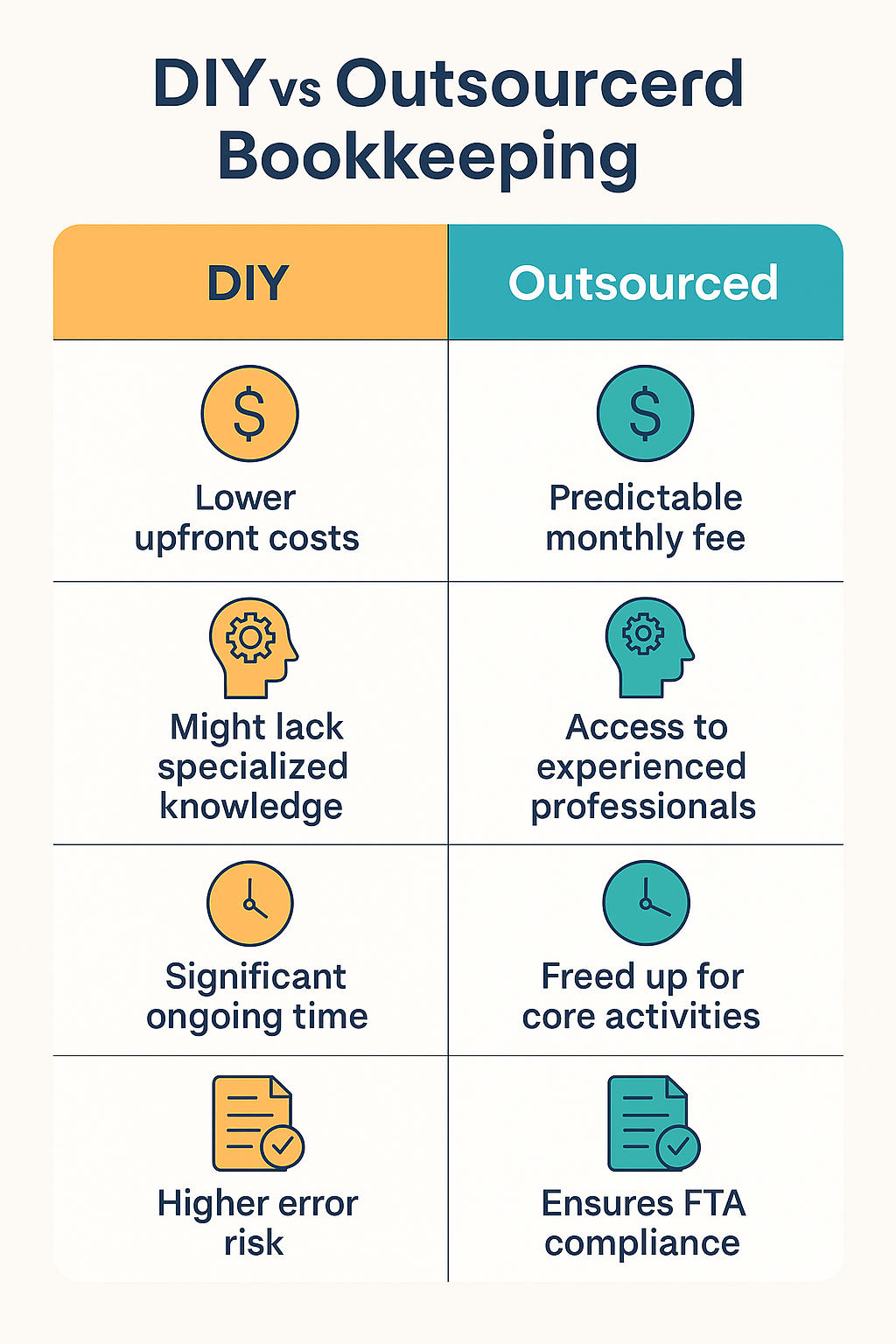
| Feature | DIY Bookkeeping | Outsourced to ProAct |
|---|---|---|
| Time Investment | High | Low |
| Error Risk | High (non-experts) | Low (4-layer review process) |
| Compliance Confidence | Uncertain | Guaranteed with FTA regulations |
| Cost | Low upfront | Cost-effective long term |
| Strategic Insights | Limited | Included monthly analysis report |
📌 Talk to ProAct for expert outsourced bookkeeping support
Cost of Bookkeeping Services in UAE (2025 Update)
| Business Type | Monthly Cost Range (AED) |
|---|---|
| Freelancer/Solo Trader | 750 – 1000 |
| Small Business (1-5 staff) | 1000 – 2,000 |
| Medium Enterprise | 2,000 – 4,000+ |
| Big Enterprises | 2,000 – 5,500+ |
💬 Custom Quotes Available: Book a free discovery session with ProAct.
Step-by-Step Monthly Bookkeeping Checklist
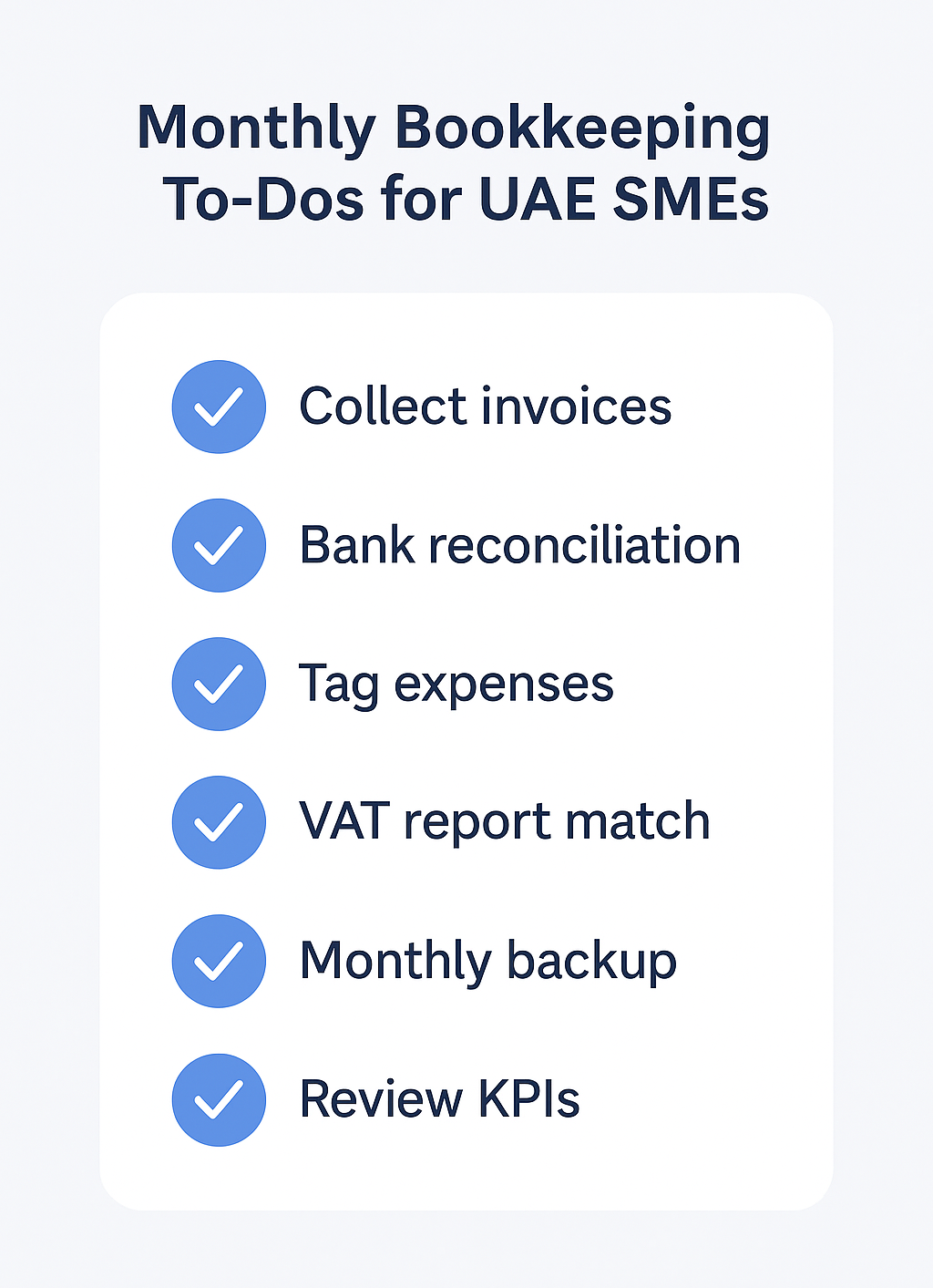
✅ Collect all invoices
✅ Reconcile all bank and credit card accounts
✅ Update expense entries with receipts
✅ Run VAT report checks
✅ Classify transactions correctly
✅ Backup data (cloud + local)
✅ Review financial KPIs
Top Tools & Software for UAE Bookkeeping
The right software can make or break your bookkeeping efficiency and FTA compliance.
- Zoho Books UAE version – FTA approved, fully VAT-integrated, supports Arabic invoices and e-invoicing
- Xero – Cloud-based, multi-currency, best for SMEs with cross-border needs
- QuickBooks Online – Easy-to-use dashboard, mobile app access, ideal for service-based businesses
- Tally ERP 9 – Still popular among legacy businesses, especially in inventory-based operations
🔗 Discover how ProAct integrates Zoho, Xero, and QuickBooks into a full accounting solution.
FTA-Ready Documentation & Record-Keeping Tips
💡 Tip: Use OCR-based software to digitize physical receipts.
📂 Required Documents:
- Invoices & receipts (incl. VAT)
- Contracts, MOAs
- Payroll slips
- Bank statements
- Inventory reports
- Lease agreements
Ensure storage for 5 years (7 for real estate entities).
Free Zone vs Mainland Bookkeeping Differences
Understanding how compliance varies by jurisdiction is essential for SMEs operating in the UAE.
| Criteria | Free Zone | Mainland |
|---|---|---|
| VAT Scope | Varies; Designated Zones (e.g., DAFZA) may be exempt from certain VAT rules | VAT applies to most supplies and services |
| Audit Requirement | Mandatory in many zones like DMCC, JAFZA, RAKEZ | Optional unless: revenue exceeds threshold, company type is legally required, or required by stakeholders |
| Reporting Format | Varies by authority; uses zone-specific portals (e.g., DMCC e-Services) | Standardized via FTA portal and IFRS |
| Corporate Tax | 0% for Qualifying Free Zone Persons (QFZPs), subject to conditions | 9% if taxable income > AED 375,000 |
| QFZP Conditions | Must maintain adequate substance in the Free Zone, derive no mainland income, and perform qualifying activities | Not applicable |
🔗 DMCC Official Portal, JAFZA, FTA Corporate Tax Guidance
Impact of UAE Corporate Tax on Bookkeeping
With 9% corporate tax now in force:
- 📘 Taxable Income: Books must separate deductible vs non-deductible expenses.
- 🔄 Tax Grouping: Consolidated records needed if part of a tax group.
- 📎 Transfer Pricing: Related-party transactions require documentation backed by proper ledgers.
- 🧾 Loss Carryforward: Historical records vital to claim tax loss relief.
📢 Need help? ProAct ensures complete tax-compliant bookkeeping aligned with corporate tax rules.
IFRS vs Local Accounting Standards in the UAE
All UAE businesses must use International Financial Reporting Standards (IFRS)—especially for:
- Asset classification
- Lease accounting
- Consolidated statements
- Segment reporting
💡 ProAct accountants are IFRS-certified and trained on UAE-specific applications.
Real-World Case Studies: How ProAct Helped UAE SMEs
🎯 E-commerce Retailer – Dubai Free Zone
Issue: VAT mismatches
Solution: ProAct digitized bookkeeping, automated VAT reports
Result: AED 20,000 saved in penalties
📦 Logistics Firm – Sharjah Mainland
Issue: Delayed monthly reporting
Solution: Integrated Zoho with live dashboard
Result: 3-week reduction in financial closing time
How AI Is Transforming UAE Bookkeeping in 2025
Artificial Intelligence is no longer a futuristic trend—it’s actively reshaping how UAE businesses handle their books.
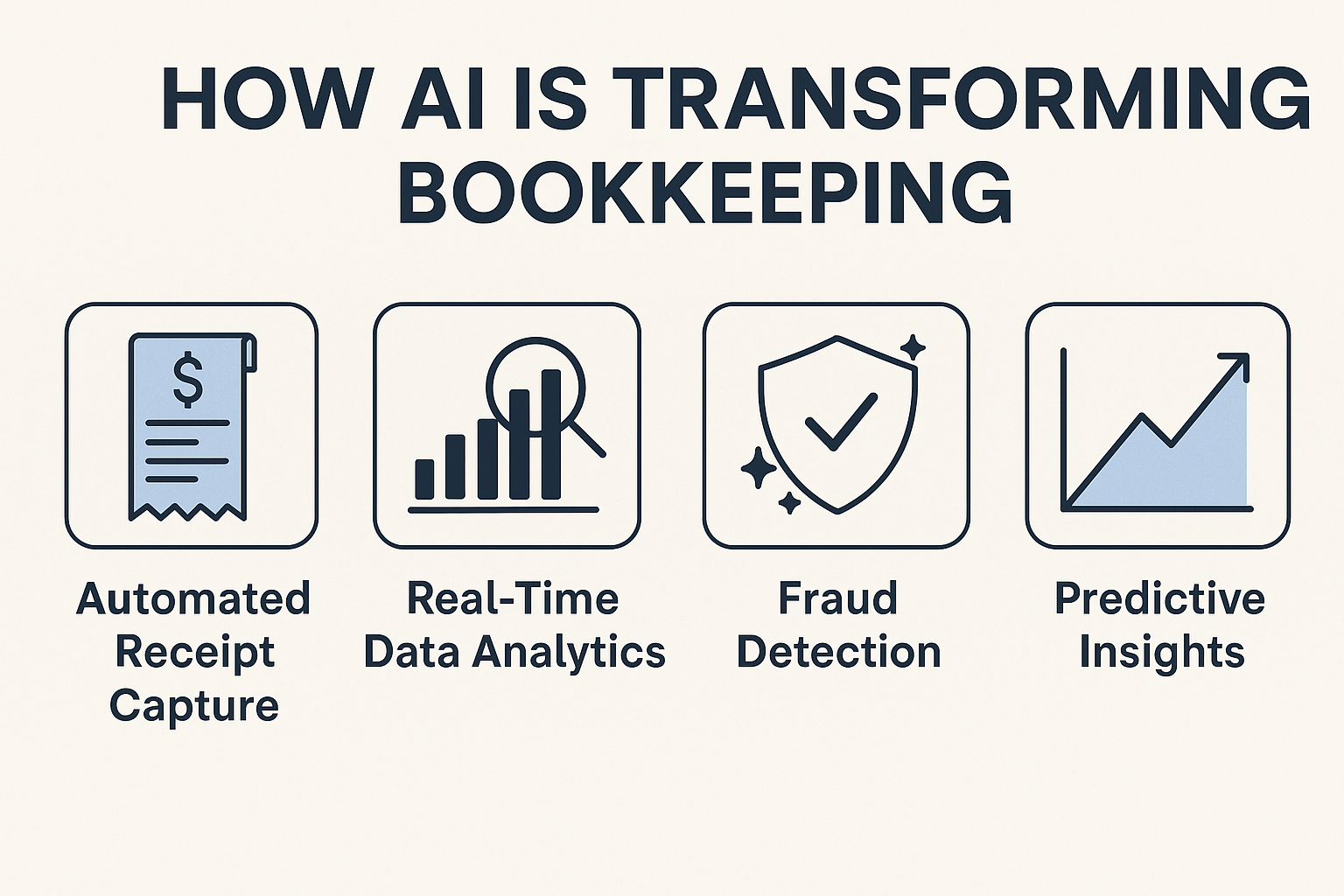
🧠 ProAct’s AI Dashboard (Launching Q4 2025)
- 📸 Automated Receipt Capture: OCR technology reads receipts and auto-fills your expense logs.
- 🔄 Smart Reconciliation: Matches transactions across bank feeds and accounting software with near-zero error rates.
- 🧾 VAT Pattern Recognition: Learns from past data to flag inconsistencies before filing.
- 💬 WhatsApp Integration: Submit receipts and track status via a mobile chat interface.
🔍 AI in the Wider UAE Bookkeeping Landscape:
- Predictive Analytics: Forecasts future cash flows based on historical patterns and payment behaviors.
- Fraud Detection: Machine learning flags duplicate entries or anomalies in vendor payments.
- Smart Categorization: AI classifies recurring transactions and learns industry-specific rules over time.
📊 Stat Insight: A 2024 UAE FinTech Outlook report found that SMEs using AI-based bookkeeping saw an 80% reduction in manual errors and 40% faster financial close cycles.
Top 10 Bookkeeping KPIs for SME Owners
- Net Profit Margin
- Average Days to Reconcile
- Unmatched Transactions
- Accounts Payable Days
- Gross Profit Percentage
- Monthly Bookkeeping Turnaround
- Number of Errors Flagged
- VAT Return Accuracy Rate
- Cash Flow Coverage Ratio
- Expense-to-Revenue Ratio
Choosing the Right Bookkeeper: Key Criteria
- ✅ FTA & IFRS Experience
- ✅ Client Testimonials/References
- ✅ Clear Communication Style
- ✅ Industry Specialization
- ✅ Cloud Accounting Proficiency
- ✅ Fixed Pricing & Scope Clarity
- ✅ Responsiveness to Queries
📞 Hire a Trusted UAE Bookkeeper with ProAct
Checklist: Documents Required for Monthly Bookkeeping
📂 Sales invoices
📂 Expense receipts
📂 Purchase orders
📂 Payroll records
📂 VAT return copy
📂 Utility bills
📂 Bank and card statements
ProAct’s 4-Layer Review Process: Ensuring Accuracy
- Junior Bookkeeper logs and tags entries
- Senior Accountant reconciles and verifies compliance
- Account Manager reviews tax and IFRS application
- Partner-Level Review offers strategic insights and final sign-off
🎯 Ensures every file meets FTA, audit, and internal control standards.
Red Flags That Signal Poor Bookkeeping
🚨 Missed VAT filing dates
🚨 No supporting documents for key expenses
🚨 Use of Excel with no audit trail
🚨 Bank statement discrepancies
🚨 No profit/loss visibility
💬 If these sound familiar, contact ProAct to fix your books before penalties occur.
Why ProAct Is the Right Partner
With over many UAE clients and deep expertise across Free Zone and Mainland bookkeeping, ProAct is your go-to solution for accurate, compliant, and insight-driven accounting services.
📞 Schedule your free consultation with ProAct today
Frequently Asked Questions (FAQs):
1. What is bookkeeping in UAE and why is it important?
Bookkeeping is the systematic recording of financial transactions. In the UAE, it’s essential to comply with VAT and corporate tax laws.
2. Is bookkeeping mandatory for all UAE businesses in 2025?
Yes, under FTA regulations, all businesses must maintain accurate financial records.
3. How long do I need to retain bookkeeping records in the UAE?
5 years from the end of the financial year, as per UAE tax law.
4. Can I do bookkeeping myself as a freelancer in the UAE?
Yes, but it’s recommended to use tools or outsource to avoid costly VAT errors.
5. What happens if I don’t keep proper financial records in the UAE?
You risk FTA penalties up to AED 10,000 or more for each violation.
6. Which software is best for UAE bookkeeping?
Zoho Books, Xero, and QuickBooks are all UAE-VAT ready.
7. Are Free Zone companies required to follow the same rules?
Most Free Zones enforce bookkeeping, especially if audits are required.
8. How much does monthly bookkeeping cost in the UAE?
Starting from AED 750 for small freelancers, up to AED 5,000+ for complex businesses.
9. Does ProAct offer bookkeeping packages for small businesses?
Yes, we offer scalable packages based on business size and industry.
10. Can poor bookkeeping affect my corporate tax filing?
Absolutely. It can lead to incorrect taxable income and penalties.
11. Does ProAct handle bookkeeping for e-commerce sellers?
Yes, we support Amazon, Noon, Shopify, and local sellers.
12. How often should bookkeeping be updated?
Monthly is best, though weekly is ideal for high-volume businesses.
13. What is the difference between accounting and bookkeeping?
Bookkeeping is recording; accounting involves analysis and reporting.
14. Will my company be audited if I outsource bookkeeping?
Not necessarily, but having clean books makes audits easier.
15. Can ProAct help with VAT refunds?
Yes, we ensure books are VAT-accurate for successful refund applications.
16. What documents should I submit monthly?
Invoices, bank statements, receipts, payroll records, VAT returns.
17. Can I migrate from Excel to Zoho or Xero with ProAct’s help?
Yes, we handle full migration with no data loss.
18. Does bookkeeping help with cash flow management?
Yes, tracking payables/receivables improves liquidity visibility.
19. Is cloud bookkeeping secure in the UAE?
Yes, ProAct uses encrypted platforms and data backup protocols.
20. How do I get started with ProAct bookkeeping services?
Simply contact us, and our team will schedule a free consultation.
Final Thoughts: The Future of UAE Bookkeeping Beyond 2025
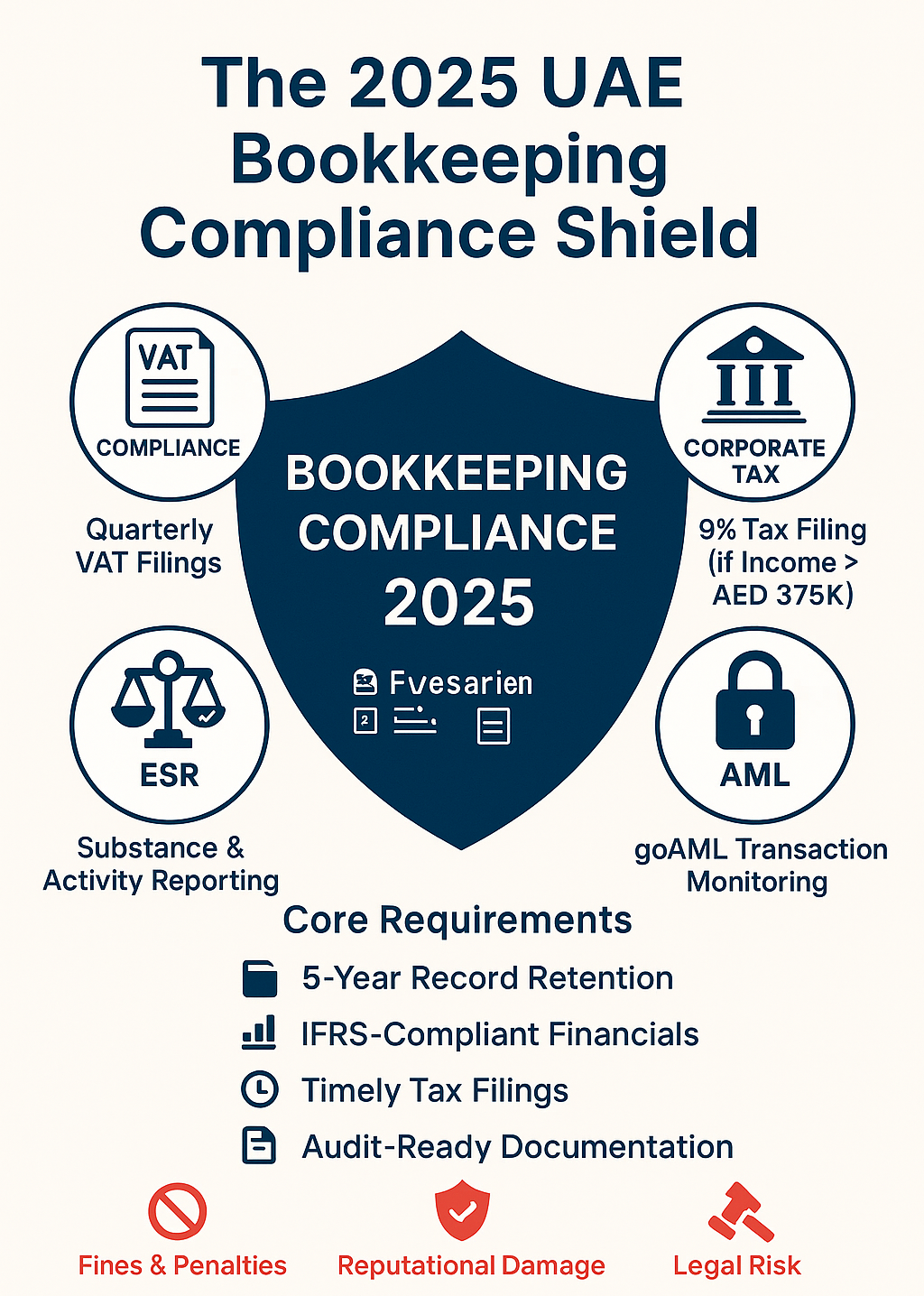
Bookkeeping is no longer optional—it’s your compliance shield, your cash flow compass, and your investor report card.
💡 Forward Outlook: As the UAE advances toward a fully digital economy by 2030—driven by government initiatives like UAE PASS and the paperless strategy—real-time, cloud-based, and AI-enhanced bookkeeping will define operational excellence.
🧭 The businesses that thrive will be those that build their financial infrastructure not just for today’s taxes—but for tomorrow’s transformation.
📞 Let ProAct help you future-proof your finances with compliant, tech-enabled bookkeeping.
Legal Disclaimer
This article provides general information regarding UAE bookkeeping, VAT, and tax regulations as of 2025. It is intended for informational purposes only and does not constitute financial, legal, or tax advice. Businesses should consult licensed accounting and tax professionals for personalized guidance.
Author Bio:
Written By,