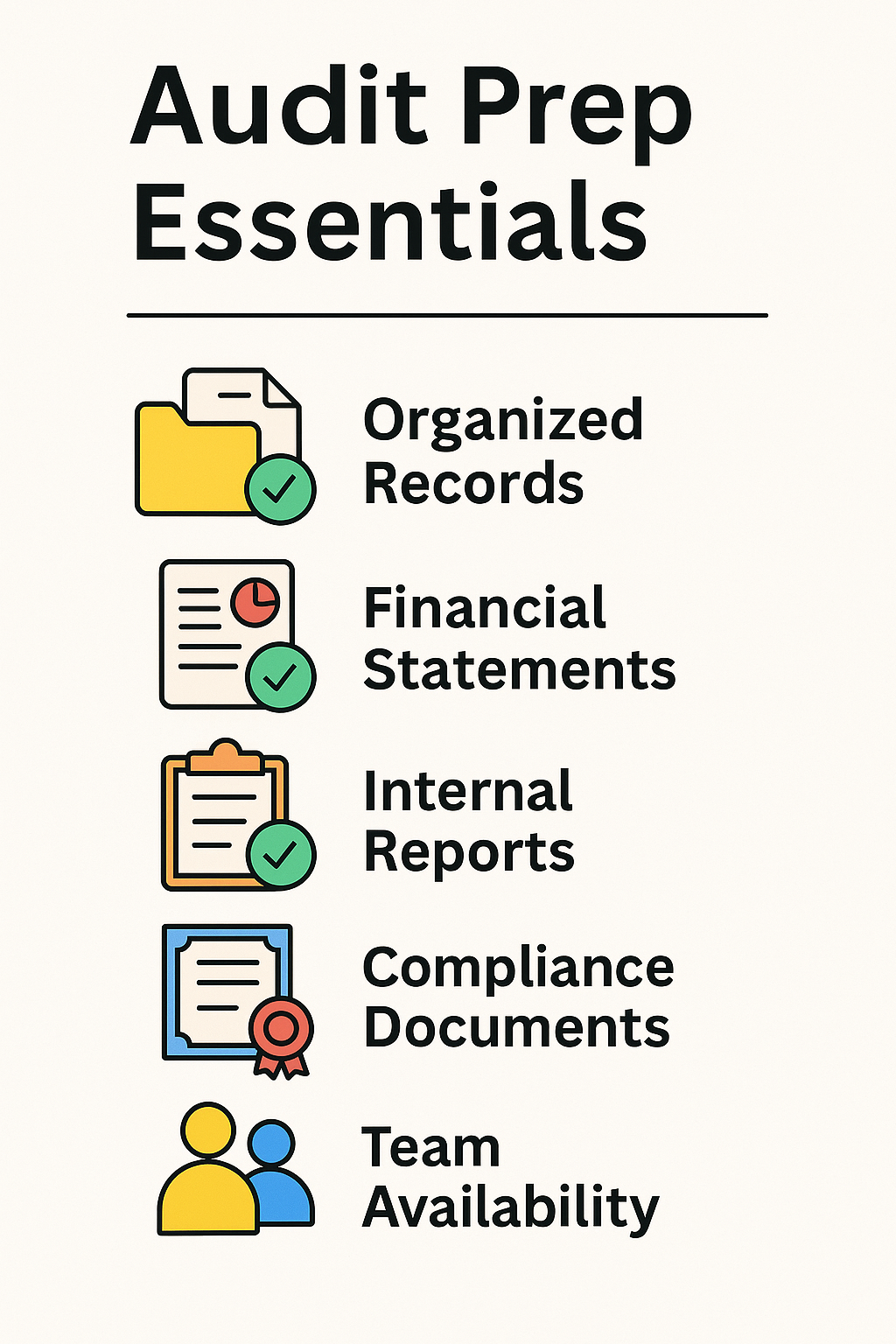
The UAE’s regulatory landscape has evolved rapidly. Consequently, businesses across the Emirates face increasing pressure to stay compliant with audit, VAT, and tax obligations. As a result, hiring a licensed external auditor is no longer just a formality — it’s a critical step for ensuring transparency, compliance, and credibility.
Talk to ProAct for licensed, reliable, and independent external auditing in the UAE.
What is an External Auditor?
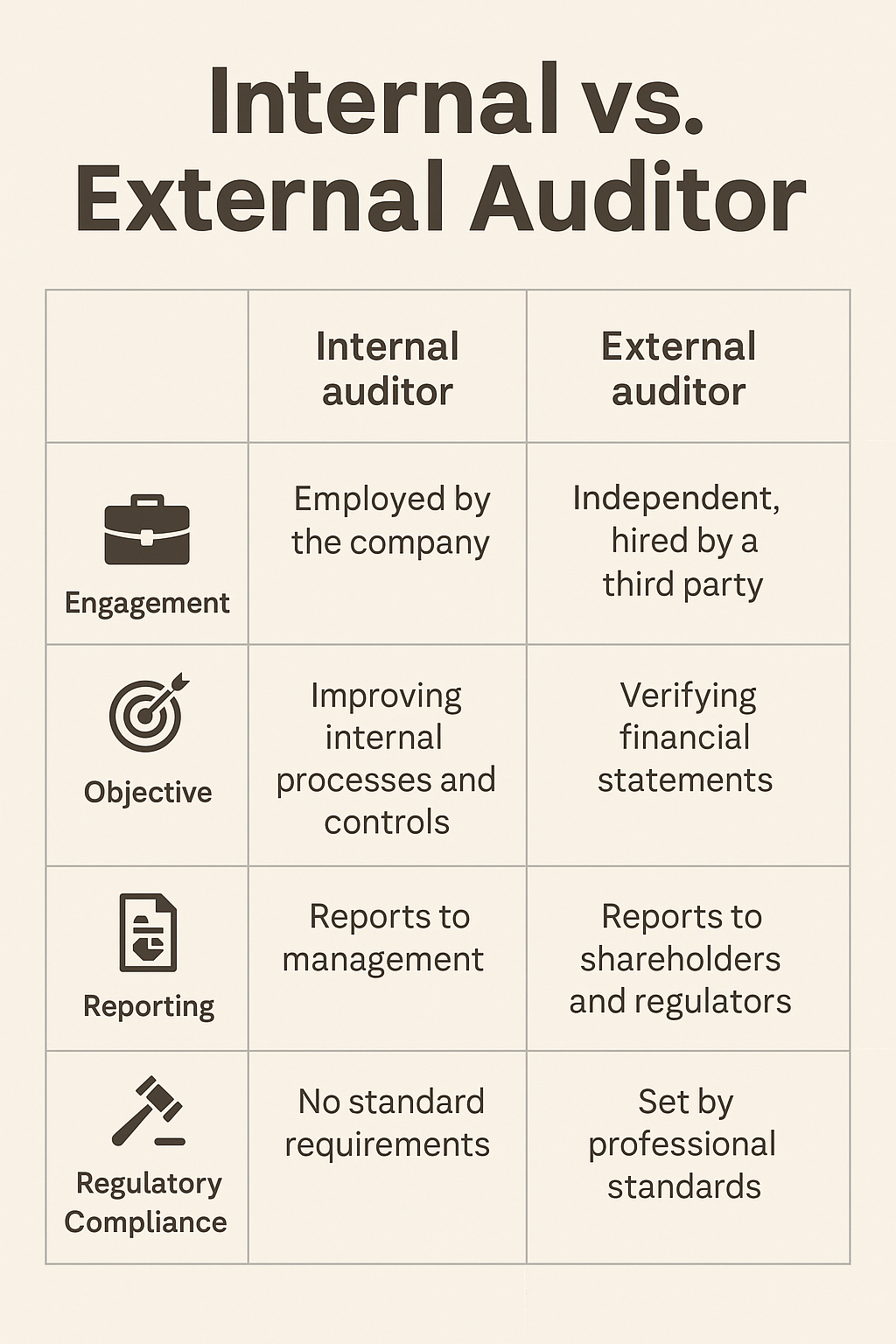
An external auditor is an independent professional or firm authorized to examine and certify a company’s financial statements. Unlike internal auditors who work within an organization, external auditors are unbiased, offering objective verification of financial health and compliance.
This neutrality is vital when engaging stakeholders like government authorities, banks, or investors.
UAE Audit Requirements for Businesses
According to the UAE Commercial Companies Law, businesses incorporated in the mainland or licensed in free zones are obligated to conduct annual audits.
Regulatory Summary:
Mainland Companies: Annual audit required by law.
Free Zones (e.g., DMCC, RAKEZ, IFZA): Most require submission of audited accounts for license renewal.
FTA Registered Entities: Must maintain audited books for corporate tax and VAT filing. See FTA official site.
Additionally, companies under Corporate Tax regulations must ensure compliance through proper financial disclosures, supported by external audits.
Why External Audits Matter: Top Business Benefits
Here’s why UAE businesses should hire certified external auditors:
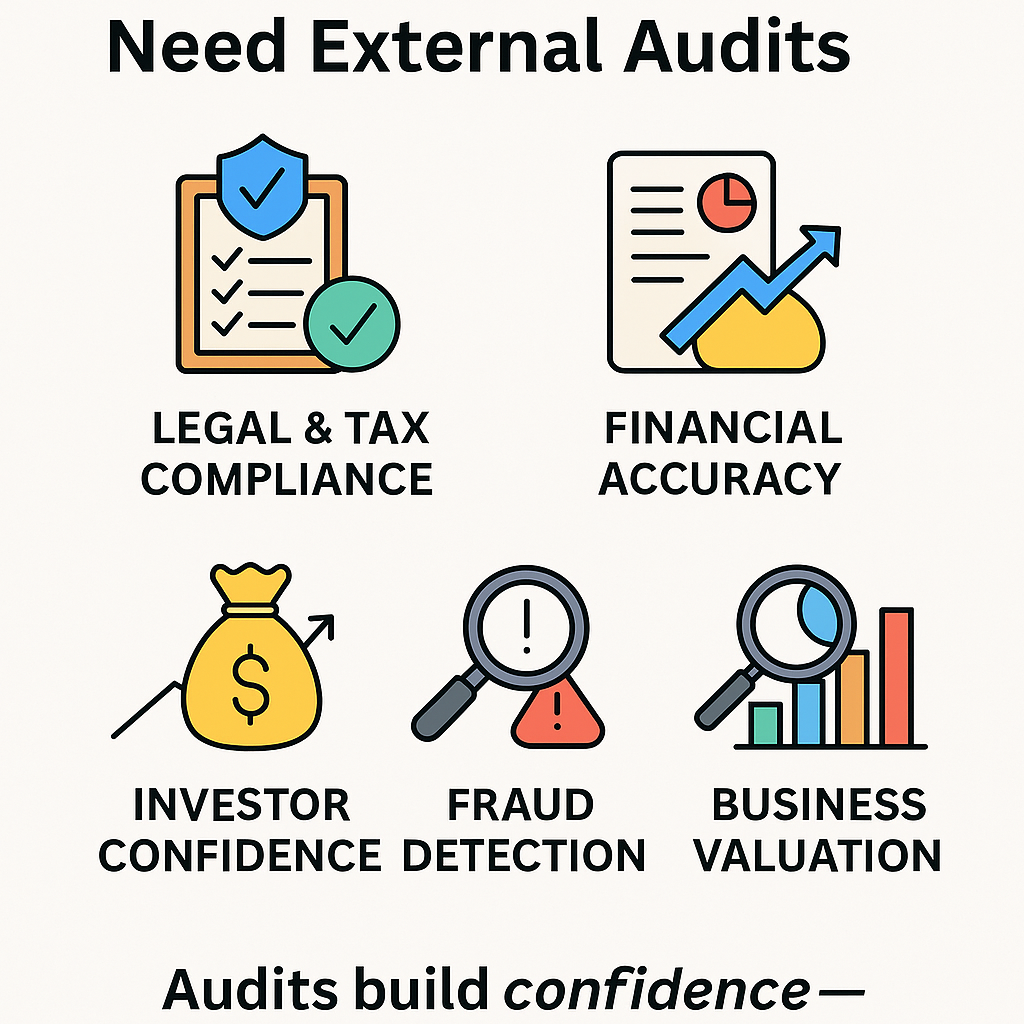
✅ Legal & Tax Compliance – Avoid penalties by meeting FTA, VAT, and CT regulations.
✅ Investor & Lender Confidence – Audited financials boost your credibility in funding rounds and bank loan applications.
✅ Accurate Financial Statements – Detect and correct discrepancies early.
✅ Business Valuation Support – Required during mergers, acquisitions, and shareholder transitions.
✅ Reputation Enhancement – Clients, suppliers, and regulators view audited businesses as trustworthy.
Includes financial audit, basic tax review, and report issuance.
Future of Auditing in the UAE
The audit industry is evolving. UAE firms like ProAct are adopting:
AI-powered reconciliations
Blockchain audit trails
Real-time dashboards via EmaraTax
Cloud collaboration tools
These innovations reduce errors, cut time, and improve compliance visibility.
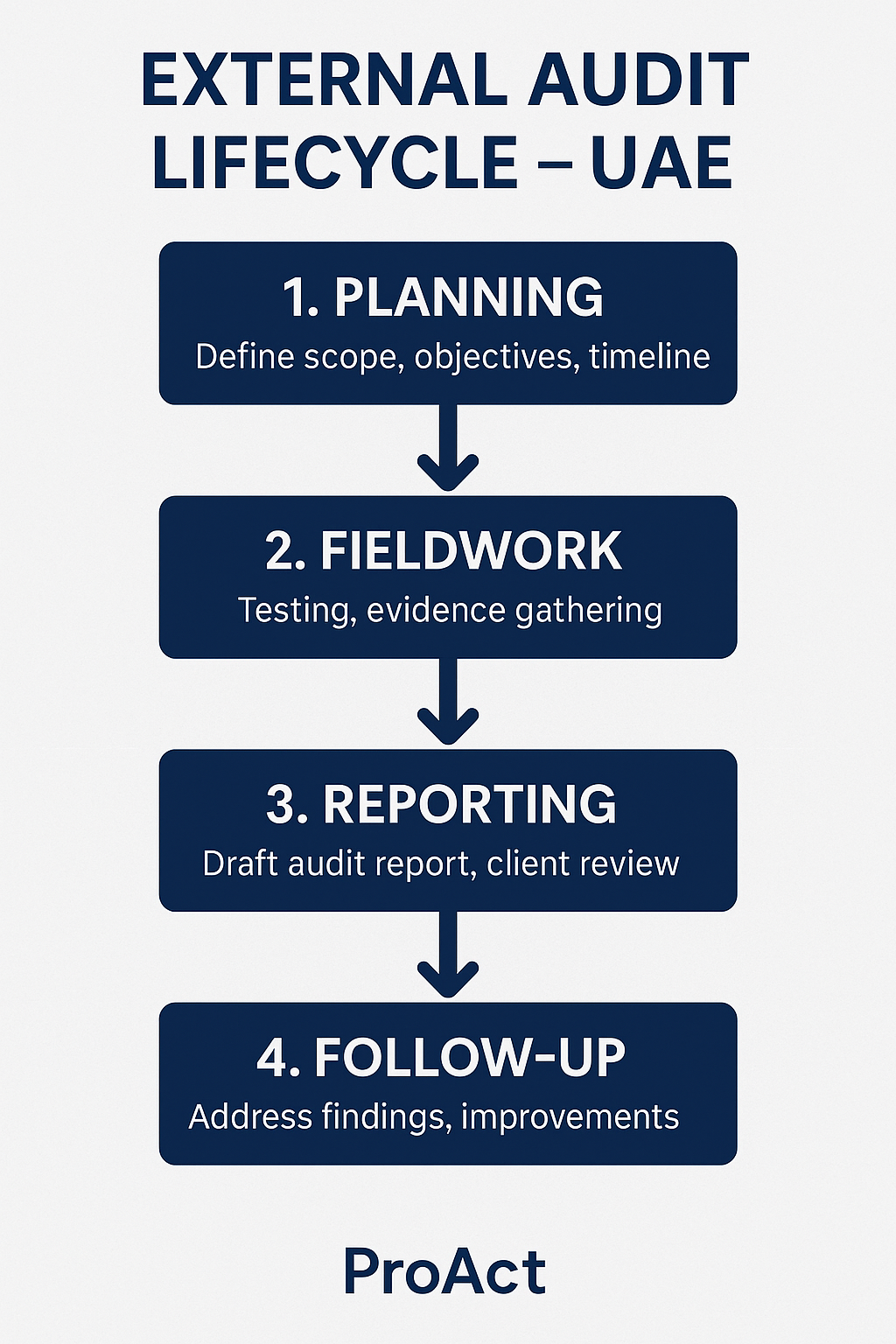
External Audit Lifecycle – UAE
The external audit process in the UAE typically follows four key phases:
Planning – The auditor assesses the business, defines scope, and identifies risk areas.
Fieldwork – Detailed examination of financial records, VAT filings, and internal controls.
Reporting – An audit report is issued based on IFRS and UAE regulatory standards.
Follow-Up – Recommendations are provided to improve compliance and resolve issues.
Understanding this lifecycle ensures smoother audits, regulatory compliance, and stronger financial governance.
Frequently Asked Questions (FAQs)
Q1: Is an external audit mandatory in UAE? Yes. Most free zones and mainland companies require it for license renewal and compliance.
Q2: What’s the difference between external and internal audit? Internal is for internal control; external is independent and focuses on financial accuracy.
Q3: Can I choose any auditor in UAE? No. They must be registered with the Ministry of Economy (MOE).
Q4: Do small businesses need external audits? Yes, especially if operating in regulated sectors or free zones.
Q5: What’s included in an external audit? Review of financial records, internal controls, tax compliance, and audit report issuance.
Q6: How long does a typical audit take? Usually 1–4 weeks, depending on your record readiness.
Q7: How much does a UAE audit cost? Starts at AED 3,000 for small firms; varies with size and complexity.
Q8: Is VAT audit part of external audit? Yes, many external audits include VAT reconciliation and risk assessment.
Q9: Can ProAct handle urgent audits? Yes, we offer express audits for license renewals or investment deadlines.
Q10: What sectors do you specialize in? Healthcare, logistics, tech, retail, construction, services.
Q11: Are ProAct audits accepted by UAE banks? Yes. Our reports meet all banking and regulatory standards.
Q12: Do you help with tax audit readiness? Absolutely. We prepare documentation for FTA review and provide audit defense.
Q13: What if I’ve never been audited before? No problem. We’ll guide you through every step and prepare your team.
Q14: Is an audit needed for VAT deregistration? FTA may request it. Better to be prepared with an audit report.
Q15: What platforms do you work with? Zoho, QuickBooks, Xero, Tally, and more.
Q16: Do I need audited accounts for corporate tax filing? Yes, to ensure accuracy and avoid FTA disputes.
Q17: Can ProAct do remote audits? Yes, via secure cloud platforms and video interviews.
Q18: Do you audit DIFC or ADGM firms? Yes, including regulated financial institutions.
Q19: Will I get bilingual audit reports? Yes. English & Arabic options available.
Q20: How can I book a consultation? Contact us now or call +971-59-725-6685 for a free assessment.
Conclusion
Need a licensed, trusted external audit partner in UAE? 💼 Let ProAct handle your audit, tax, and compliance with confidence. 📩 Get Your Audit Quote Today →
Author Bio:
Written By,
SHABAN KUNCHERIA
CA. Shaban Kuncheria (FCA) is a seasoned Chartered Accountant with over 18 years of post-qualification experience across India, Qatar, and the UAE. A Fellow of the Institute of Chartered Accountants of India (ICAI), he specializes in audit, corporate tax, financial management, and compliance.
Shaban has led finance functions for multinational groups in industries such as construction, trading, manufacturing, hospitality, and software development, and has collaborated with global firms including Deloitte, KPMG, and Ernst & Young. His expertise also extends to ERP implementation and business restructuring, helping organizations strengthen governance and achieve sustainable growth.